
If you own a set of kitchen knives, you probably know the frustration of a dull blade. Even high-quality knives like those from Henckels lose their sharp edge over time. But the right sharpener can bring them back to life. Many home cooks hesitate to sharpen their knives, afraid they’ll damage the blade or use the tool incorrectly. The good news is, using a Henckels knife sharpener is easier than you might think, and doing it right can make cooking safer and more enjoyable.
This guide will walk you through everything you need to know. Whether you own a manual or electric Henckels sharpener, you’ll learn how to use it step by step, avoid common mistakes, and keep your knives in top condition. Let’s get started and turn your kitchen knives into reliable tools again.
Why Knife Sharpness Matters
A sharp knife is not just about convenience—it’s a matter of safety and efficiency. When your knife is sharp, it requires less force to cut through foods. This means you have more control and are less likely to slip and cut yourself. Chopping tomatoes, slicing bread, or mincing herbs becomes smoother and less frustrating.
According to a survey by the National Safety Council, dull knives are responsible for about 30% of kitchen accidents involving cuts. A dull knife can crush or tear food instead of making clean cuts, damaging both the food and your patience. That’s why regular sharpening is essential, not just a luxury for professionals.
Types Of Henckels Knife Sharpeners
Henckels offers several types of sharpeners, each designed for different needs. Understanding their differences helps you choose the right one and use it correctly.
Manual Pull-through Sharpeners
These are the most popular Henckels sharpeners for home cooks. They feature one or more slots with sharpening stones inside. You pull the knife through the slot, and the stones reshape and refine the edge.
Advantages:
- Easy for beginners
- Safe design with a handle and non-slip base
- Quick sharpening (usually under 2 minutes)
Limitations:
- Less control over blade angle
- Not suitable for serrated knives
Honing Steel (sharpening Steel)
A honing steel isn’t a sharpener in the traditional sense. Instead, it realigns the microscopic teeth on the edge of your blade, keeping it sharp between actual sharpening sessions. Henckels includes a honing steel with many knife sets.
Advantages:
- Maintains sharpness between sharpenings
- Fast and simple to use
Limitations:
- Does not remove metal or fix a dull edge
- Requires proper technique
Electric Sharpeners
Electric Henckels sharpeners use motorized wheels to grind and polish the knife edge. They offer speed and consistency, ideal for people who sharpen knives often.
Advantages:
- Fast and effortless
- Consistent results
Limitations:
- More expensive
- Remove more metal, shortening blade life if overused
Whetstones
Some advanced Henckels users prefer whetstones for maximum control. This traditional method requires practice but delivers the sharpest results.
Advantages:
- Customizable edge angle
- Great for high-end knives
Limitations:
- Steep learning curve
- Time-consuming
The table below compares the main types:
| Type | Ease of Use | Control | Maintenance Level | Speed |
|---|---|---|---|---|
| Manual Pull-Through | Easy | Moderate | Low | Fast |
| Honing Steel | Easy | High | Very Low | Very Fast |
| Electric Sharpener | Very Easy | Low | Low | Very Fast |
| Whetstone | Difficult | Very High | High | Slow |

Credit: www.amazon.com
How To Prepare Your Knife And Sharpener
Before sharpening, a little preparation goes a long way in getting the best results and avoiding damage.
- Clean Your Knife: Wash and dry your knife. Any leftover food or grease can affect sharpening and may scratch the blade.
- Check the Sharpener: Make sure your Henckels sharpener is clean and free of debris. For pull-through models, check the slots for metal shavings.
- Choose a Safe Surface: Place the sharpener on a stable, flat surface. A countertop with a non-slip mat is ideal.
- Read the Manual: If you’re using a new sharpener, review the instructions. Different models may have unique features or safety tips.
Many beginners skip cleaning the knife and sharpener, leading to uneven results or possible contamination. Taking a minute to prepare prevents these issues.
Step-by-step: Using A Henckels Manual Pull-through Sharpener
The pull-through sharpener is the most common Henckels model found in homes. Here’s how to use it correctly for straight-edged knives.
- Place the Sharpener: Set it on a stable, non-slip surface. Hold the handle firmly with your non-dominant hand.
- Select the Right Slot: Most Henckels sharpeners have two slots: one coarse (for dull knives) and one fine (for honing or regular maintenance). Start with the coarse slot if your knife is very dull.
- Insert the Knife: Place the heel of the blade (closest to the handle) into the slot. Keep the blade perpendicular (90 degrees) to the sharpener.
- Pull Steadily: Apply light, even pressure. Pull the blade through the slot from heel to tip, following the natural curve. Do not push back and forth.
- Repeat: Run the blade through the slot 3–6 times, depending on dullness. For minor touch-ups, 1–2 passes in the fine slot may be enough.
- Switch to Fine Slot: For the sharpest edge, finish with 2–3 pulls in the fine slot.
- Wipe the Blade: After sharpening, wipe the blade with a damp cloth to remove any metal particles.
A common mistake is pressing too hard. Gentle pressure is enough—too much force can damage the edge or wear the sharpener quickly.
How To Use A Honing Steel
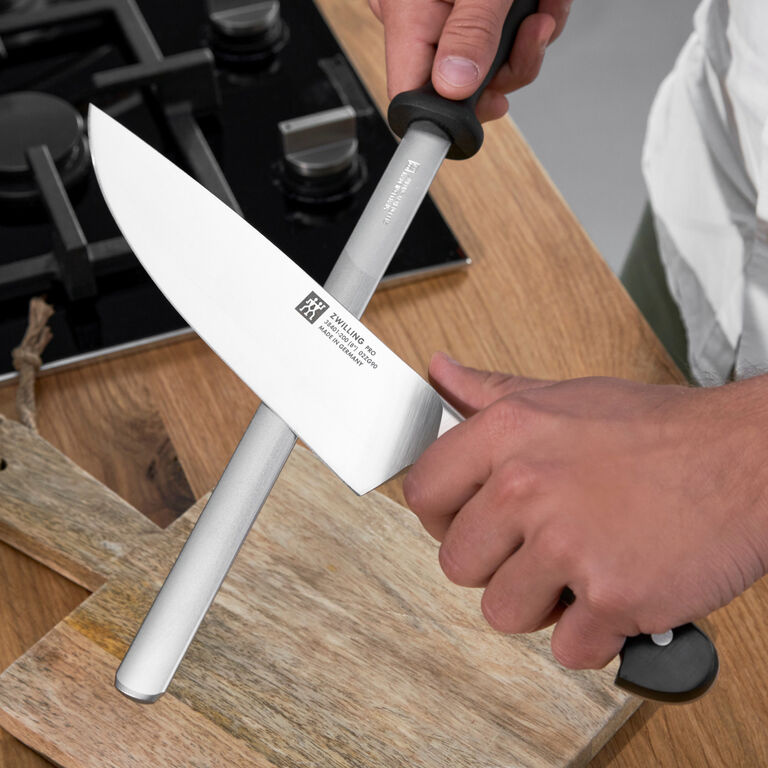
Honing your knife helps keep it sharp between full sharpenings. Here’s how to use a Henckels honing steel:
- Hold the Steel Vertically: Stand the tip on a towel or cutting board for safety. Hold the handle at shoulder height.
- Set the Angle: Place the heel of the knife against the steel at a 15–20-degree angle. For Henckels knives, 15 degrees is ideal.
- Sweep the Blade: Starting at the heel, sweep the blade down the steel while moving from heel to tip. Use a smooth, controlled motion.
- Alternate Sides: Repeat on the other side of the steel. Do 5–8 passes per side.
- Test the Edge: Slice through a piece of paper or a tomato. If the knife cuts cleanly, you’re done.
A key detail: honing does not actually sharpen or remove metal. It just realigns the edge, so do not skip actual sharpening if your knife is already dull.
Using A Henckels Electric Sharpener
Electric sharpeners are popular for busy cooks or those with many knives. Here’s the safe and effective way to use one:
- Read Instructions: Each electric model is a bit different. Review your Henckels manual for any special steps.
- Plug In and Secure: Place the sharpener on a dry, stable surface. Plug it in and turn it on.
- Start with Coarse Slot: Insert the knife into the leftmost slot, heel first. Pull the knife through slowly and smoothly.
- Repeat as Needed: Most knives need 2–4 passes in each slot. If the blade is very dull, start with the coarse, then use medium and fine slots.
- Wipe and Test: After sharpening, clean the blade and test the sharpness.
Electric sharpeners are fast, but they can remove more metal than necessary. Use them for regular sharpening, not every week.

Credit: www.youtube.com
When Should You Sharpen Your Knife?
Sharpening too often can wear out your knife, but waiting too long is dangerous. Here are the best ways to know when it’s time:
- Paper Test: Try slicing a piece of printer paper. If the blade tears or catches, it needs sharpening.
- Tomato Test: A sharp knife should cut through tomato skin without squashing it.
- Frequency: For home cooks, sharpening every 2–3 months is enough. If you use your knives daily, check them monthly.
- Edge Reflection: Hold the knife under a light. If you see shiny spots along the edge, those are dull areas.
Remember, honing can be done every week, but full sharpening should be less frequent.
Common Mistakes To Avoid
Even with a good sharpener, mistakes can ruin your knife or shorten its life. Watch out for these:
- Using the Wrong Angle: Most Henckels knives need a 15-degree angle. Using a different angle can create a dull or uneven edge.
- Applying Too Much Pressure: Let the sharpener do the work. Excess force can chip or bend the blade.
- Not Cleaning Before/After: Metal particles can scratch your knife or contaminate food.
- Ignoring Serrated Knives: Standard sharpeners are not for serrated blades. Use a special tool or professional service.
- Sharpening Too Often: Over-sharpening removes more metal, reducing the lifespan of your knife.
A surprising mistake: many users forget to wipe the blade after sharpening, leaving tiny metal bits that can end up in food.
Sharpening Serrated And Specialty Henckels Knives
Serrated knives, like bread knives, require a different approach. Manual pull-through or electric sharpeners are not suitable for these blades.
- Use a Special Rod: A tapered sharpening rod can be used to hone each serration individually.
- Professional Service: For best results, have serrated knives sharpened by a pro every 1–2 years.
Santoku and other Asian-style knives often use a 10–15-degree angle. Check your knife model before sharpening.
Maintaining Your Henckels Knife After Sharpening
Proper care extends the life of your sharp edge:
- Hand Wash Only: Dishwashers can dull the edge quickly.
- Dry Immediately: Prevent rust by drying your knife right after washing.
- Store Safely: Use a knife block, sheath, or magnetic strip. Avoid tossing knives in drawers.
- Use the Right Cutting Board: Wood or plastic is best. Glass or ceramic can dull blades fast.
Henckels knives are designed for durability, but good habits keep them sharp and safe for years.
Credit: www.zwilling.com
Comparing Henckels Sharpeners To Other Brands
How does a Henckels sharpener measure up to popular competitors like Wüsthof or Chef’sChoice? Here’s a quick comparison:
| Brand | Typical Price | Ease of Use | Sharpness Quality | Durability |
|---|---|---|---|---|
| Henckels | $20–$60 | Beginner-friendly | Very Good | High |
| Wüsthof | $30–$80 | Moderate | Excellent | High |
| Chef’sChoice | $40–$120 | Very Easy (Electric) | Excellent | High |
Henckels sharpeners stand out for their value and reliability, especially for home cooks who want quality without a steep price or learning curve.
What Makes Henckels Sharpeners Unique
Several features help Henckels sharpeners stand out:
- Angle Guides: Built-in guides help maintain the perfect angle every time, especially useful for beginners.
- Non-Slip Base: Safety is a priority, and most models include a sturdy, non-slip base.
- Multiple Stages: Many sharpeners offer both coarse and fine slots for restoring and refining.
- Designed for Henckels Steel: The abrasive materials are chosen to suit Henckels knife steel, maximizing edge retention.
An interesting fact: Henckels has been making knives since 1731, and their sharpeners are designed to match the steel composition and blade geometry of their knives.
Practical Tips For Best Results
Here are some expert tips that even experienced cooks sometimes miss:
- Sharpen Both Sides Evenly: Always alternate sides when using a honing steel or whetstone. This prevents an uneven edge.
- Don’t Oversharpen: If your knife passes the paper test, you don’t need another sharpening session.
- Store Your Sharpener Well: Keep your sharpener clean and dry. For manual pull-through models, store them in a drawer or cupboard to avoid dust buildup.
- Replace When Needed: If the abrasive material in the slots becomes smooth or worn, it’s time for a new sharpener.
Troubleshooting: If Your Knife Won’t Get Sharp
Sometimes, even after sharpening, your knife still feels dull. Here’s what to check:
- Blade Damage: Look for chips, bends, or nicks. These need professional repair.
- Wrong Tool: Are you using a pull-through sharpener on a serrated knife? If so, it won’t work.
- Too Much Pressure: This can roll the edge instead of sharpening it.
- Old Sharpener: The abrasive parts may be worn out. Try a new sharpener or another method.
If you’re consistently unhappy with your results, consider asking a professional for help or trying a different sharpening tool.
Real User Experiences
Many home cooks find that using a Henckels sharpener for the first time brings surprising results. For example, one user reported that her family’s 10-year-old Henckels chef knife was “like new” after three passes in the coarse slot and two in the fine slot—something she thought only professionals could do.
Another user found that switching from an electric sharpener to a manual pull-through model improved the life of his knives, because he could control how much metal was removed.
A less obvious insight: People who sharpen their knives regularly actually cook at home more often, finding prep work less frustrating and even enjoyable.
Safety Precautions When Sharpening Knives
Sharpening is safe if you follow some simple rules:
- Keep Fingers Clear: Always hold the handle, never the blade, when using a sharpener.
- Stable Surface: Only use on a non-slip, level surface.
- Wipe Carefully: After sharpening, clean the blade away from your hand to avoid cuts.
- Don’t Rush: Take your time. Most accidents happen when users are in a hurry.
The few seconds you save by rushing aren’t worth the risk of a cut.
Choosing The Right Henckels Sharpener For You
Not sure which sharpener to pick? Consider these factors:
- Type of Knives: If you own mostly straight-edged knives, a manual pull-through sharpener is ideal. For a mix of straight and serrated, you may need extra tools.
- Skill Level: Beginners do best with pull-through or electric models. Honing steels and whetstones require more practice.
- Budget: Manual sharpeners are affordable, while electric models cost more but save time.
- Frequency of Use: If you sharpen knives often, invest in a durable model with replaceable parts.
Here’s a quick summary for picking the right type:
| Your Need | Best Henckels Sharpener |
|---|---|
| Quick, easy sharpening | Manual Pull-Through |
| Professional-level edge | Whetstone |
| Busy kitchen, many knives | Electric Sharpener |
| Maintaining sharpness | Honing Steel |
| Serrated knives | Specialty Rod or Service |
For more details about knife sharpening, you can visit the official Henckels website.
Frequently Asked Questions
What Is The Correct Angle For Sharpening A Henckels Knife?
Most Henckels knives are designed to be sharpened at a 15-degree angle. This creates a sharp, durable edge perfect for most kitchen tasks. Using the correct angle is important for maintaining the blade’s performance.
How Often Should I Sharpen My Henckels Knives?
For regular home use, sharpening every 2–3 months is enough. If you cook daily, check the edge monthly and sharpen as needed. Use a honing steel weekly to keep the edge aligned between sharpenings.
Can I Use A Henckels Sharpener On Other Brands?
Yes, most Henckels sharpeners work well on other straight-edged kitchen knives. However, always check the recommended angle for your knife’s brand. Some Japanese knives, for example, use a 10–12-degree angle.
Is A Honing Steel The Same As A Sharpener?
No. A honing steel straightens the blade’s edge but does not remove metal or restore a dull edge. A sharpener (manual, electric, or whetstone) actually grinds and sharpens the blade. Use both for best results.
What Should I Do If My Knife Is Still Dull After Sharpening?
If your knife remains dull, check for blade damage or worn-out sharpener parts. Make sure you’re using the right technique and angle. For stubborn cases, consider professional sharpening or trying a different tool.
Keeping your Henckels knives sharp is one of the best ways to make cooking safe and enjoyable. With the right sharpener and a little practice, you’ll have blades that slice cleanly and last for years. Sharpening may seem intimidating at first, but once you start, you’ll wonder how you ever managed without it.

Hello, This is Annie Walker, a 38-year-old blogger, founder, and editor of Cookware Guider from NY, USA. I am a cookware fanatic and passionate cooker. I love to cook with different types of cooking appliances (example: all types of cookware, rice cookers, slow cookers, etc) almost every day in my kitchen. I love to share my experience with my readers in my blog. Also, I enjoy helping people to solve their problems through my website. You can follow me on Twitter & Pinterest. To know details about my blog please check the about us page.