
Sharpening your kitchen knives at home is more than a chore; it’s a skill that can transform your cooking and keep your tools safe and effective. Many home cooks struggle with dull blades, not realizing that a few well-practiced sharpening techniques can restore knives to their original glory.
With the right approach, you don’t need fancy equipment or professional services—just patience, the correct tools, and a bit of knowledge.
In this guide, we’ll explore the best knife sharpening technique you can use at home. You’ll learn how to choose the right sharpening tools, avoid mistakes that damage blades, and develop a technique that works for most knives. Whether you’re a beginner or want to refine your skills, you’ll find practical advice, clear instructions, and useful comparisons to help you sharpen knives confidently.
Let’s begin by understanding why sharpening matters, then dive into the most effective methods for home use.
Why Knife Sharpening Matters
A sharp knife is safer and more efficient. Dull blades require more force, which increases the risk of slipping and injury. They also make cutting tasks slower and less precise, leading to uneven slices or crushed ingredients. Sharpening restores the edge, making your knife glide easily through food.
According to a survey by the National Safety Council, kitchen accidents involving knives are often linked to dull blades. About 70% of reported knife injuries in home kitchens happen because the knife was not properly sharpened.
Regular sharpening also extends the life of your knives. Instead of buying new ones every few years, you keep your current tools in top condition. A well-maintained knife can last decades, saving money and reducing waste.
Understanding Knife Edges And Angle
Before you start sharpening, it’s important to know how knife edges work. The blade angle is the degree at which the two sides of the knife meet. For most kitchen knives, the angle is between 15° and 20°. Japanese knives usually have a sharper angle (12°–15°), while Western knives are slightly wider.
The edge can be:
- Straight edge: Most common, easy to sharpen.
- Serrated edge: Requires special tools, not covered in this article.
- Double bevel: Both sides of the blade are sharpened equally.
- Single bevel: Only one side is sharpened, found in some Japanese knives.
Knowing your knife’s edge helps you choose the right sharpening method and maintain the proper angle for best results.
Choosing The Best Sharpening Tools
There are several ways to sharpen knives at home, but not all are equal. Let’s compare the most popular options and highlight which are best for most kitchens.
| Sharpening Tool | Skill Level Needed | Cost | Effectiveness | Common Mistakes |
|---|---|---|---|---|
| Whetstone (Water Stone) | Medium to High | $20–$80 | Excellent | Wrong angle, uneven pressure |
| Manual Sharpening Rod | Beginner | $10–$40 | Good | Doesn’t restore very dull blades |
| Electric Sharpener | Beginner | $30–$150 | Good | Can remove too much metal |
| Pull-through Sharpener | Beginner | $15–$50 | Fair | Can damage edge, inconsistent results |
Whetstone: The Gold Standard
For the best knife sharpening technique at home, the whetstone is widely recommended by chefs and experts. It gives you control over the sharpening angle, removes minimal metal, and works on most kitchen knives. While it requires some practice, the results are unmatched.
Honing Rod: Maintenance, Not Sharpening
A honing rod (also called a sharpening steel) is useful for maintaining the edge between sharpenings. It doesn’t actually sharpen but realigns the blade, making it feel sharper. Use a honing rod regularly, but rely on a whetstone for true sharpening.
Electric And Pull-through Sharpeners: Fast, But Risky
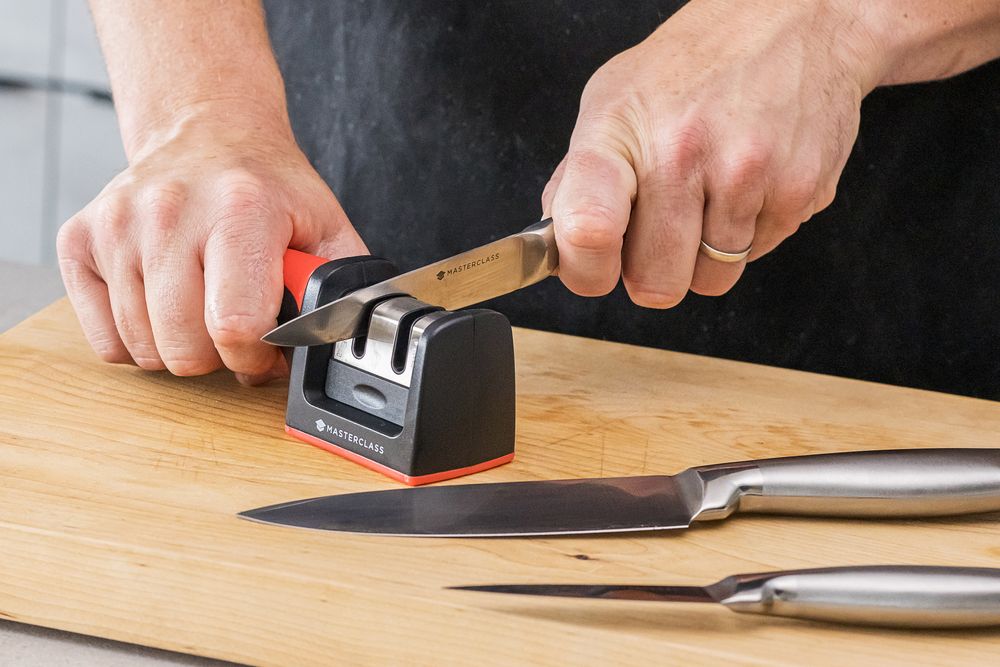
These are easy for beginners but can remove too much metal or damage the edge if used incorrectly. They’re best for quick fixes but shouldn’t replace whetstone sharpening.
Step-by-step Knife Sharpening With A Whetstone
Sharpening with a whetstone is the most effective home technique. Here’s how to do it safely and correctly.
1. Gather Your Materials
You’ll need:
- Whetstone (double-sided, 1000/6000 grit is ideal)
- Water (for soaking the stone)
- Clean cloth
- Knife
- Angle guide (optional for beginners)
2. Prepare The Whetstone
Most whetstones need to be soaked in water for 10–15 minutes. This prevents the stone from drying out and helps create a slurry that aids sharpening.
- Place the stone in a bowl of water.
- Wait until bubbles stop rising.
- Set the stone on a non-slip surface, like a damp towel.
3. Find The Correct Angle
If your knife is Japanese-style, aim for 12°–15°. For Western knives, use 15°–20°. An angle guide can help, but you can estimate by holding the blade so the edge is just above the stone.
4. Sharpen The First Side
- Place the knife on the stone at the correct angle.
- Using gentle pressure, slide the blade across the stone, from heel to tip.
- Repeat 10–15 times, keeping the angle consistent.
- For longer knives, sharpen in sections.
5. Sharpen The Second Side
Flip the knife and repeat the process on the other side. Keep the angle and pressure steady.
6. Use The Finer Grit
Turn the stone to the finer side (usually 6000 grit) and repeat the sharpening steps. This polishes the edge and removes any roughness.
7. Clean And Test
- Wipe the blade with a clean cloth.
- Rinse and dry the stone.
- Test the knife by slicing through paper or a tomato. It should cut smoothly.
Common Mistakes To Avoid
- Using too much pressure: Can damage the blade and stone.
- Skipping the finer grit: Leaves the edge rough, less sharp.
- Inconsistent angle: Results in uneven sharpening.
- Not soaking the stone enough: Reduces effectiveness.
Practical Tips For Sharpening Success
Sharpening is more than technique—it’s about developing good habits and knowing what works for your knives.
Frequency
- Home cooks: Sharpen every 2–3 months.
- Heavy users: Monthly sharpening is ideal.
- Honing: Use a honing rod every week to maintain the edge.
Knife Type Matters
Some knives need special care. For example, carbon steel knives are easier to sharpen but rust quickly. Stainless steel is harder, so sharpening takes more effort.
Visual And Auditory Cues
A well-sharpened knife edge reflects light differently. Listen for a smooth, consistent sound as you move the blade over the stone. If you hear rough scraping, the angle or pressure may be wrong.
Sharpening Curved Blades
If your knife has a curved edge (like a chef’s knife), follow the curve as you sharpen. Don’t force the blade flat against the stone.
Maintaining Your Whetstone
- Clean after each use.
- Flatten the stone regularly with a lapping plate or coarse sandpaper.
- Store in a dry place.
Comparing Sharpening Methods: Whetstone Vs. Others
Choosing the best sharpening technique means understanding how each method stacks up. Here’s a quick comparison based on user experience, cost, and results.
| Sharpening Method | Edge Quality | Safety | Ease of Use | Longevity |
|---|---|---|---|---|
| Whetstone | Excellent | High | Medium | Long-lasting |
| Electric Sharpener | Good | Medium | Easy | Shorter (removes more metal) |
| Pull-through Sharpener | Fair | Medium | Easy | Shorter |
| Honing Rod | Not sharpening (maintenance) | High | Easy | N/A |
Insight: Why Whetstone Wins
Many beginners overlook the whetstone because it feels intimidating. But it allows you to control the sharpening angle and achieve a razor-sharp edge without damaging the blade. The learning curve is worth it—after just a few sessions, most users find they get better results than with electric or pull-through sharpeners.

Credit: www.wikihow.com
Sharpening Special Knife Types
Not all knives are the same. Let’s look at how to sharpen some common variations.
Japanese Knives
- Use a lower angle (12°–15°).
- Single bevel knives require sharpening only one side.
- Japanese knives are usually thinner and need a gentle touch.
Paring Knives
- Smaller blade, easier to handle.
- Use short strokes, keep the angle steady.
Chef’s Knives
- Usually double bevel, 15°–20° angle.
- Sharpen in sections if the blade is long.
Utility Knives
- Same as chef’s knives, but shorter.
- Sharpen both sides evenly.
Non-obvious Insight
Many beginners forget to clean their knives thoroughly before sharpening. Any residue can scratch the stone or reduce sharpening efficiency. Always start with a clean blade.
How To Maintain A Sharp Edge
Sharpening is only part of the story. Keeping knives sharp requires care and maintenance.
Storage
- Use a knife block, magnetic strip, or blade guard.
- Avoid tossing knives in drawers; this dulls the edge.
Cutting Surfaces
- Use wood or plastic cutting boards.
- Avoid glass, marble, or metal surfaces.
Cleaning
- Wash knives by hand.
- Dry immediately to prevent rust.
Regular Honing
- Use a honing rod weekly.
- This keeps the edge aligned between sharpening sessions.
Non-obvious Insight
Many people believe that dishwashers are safe for knives. In reality, harsh detergents and banging against other items can dull and damage blades quickly.
:max_bytes(150000):strip_icc()/faw-primary-knife-sharpeners-aug-24-nsimpson-89-1-617608fed6bf49e5831273cd2e7e0c69.jpeg)
Credit: www.foodandwine.com
Troubleshooting Common Knife Sharpening Problems
Even with the best technique, issues can arise. Here’s how to fix them.
Blade Won’t Get Sharp
- Check if you’re using the correct angle.
- Ensure you’re using both coarse and fine grits.
- Try more strokes; some blades need extra passes.
Uneven Edge
- Use lighter, consistent pressure.
- Sharpen from heel to tip in one motion.
- Flip the knife and repeat equally on both sides.
Burr Won’t Form
- A burr is a tiny lip that forms as the edge is sharpened.
- If you don’t feel a burr, increase the number of strokes.
- Use a finer grit to remove the burr at the end.
Stone Wearing Down
- Flatten your whetstone regularly.
- Avoid pressing too hard.
Knife Rusting After Sharpening
- Dry your knife immediately.
- Store in a dry place.
Real-life Examples And Success Stories
Many home cooks discover the value of sharpening through experience. For example, Sarah, a food blogger, struggled with dull knives for years. After learning the whetstone technique, she reported that her prep time dropped by 30%. Her cuts were cleaner, and she stopped buying new knives every year.
Chef Marcus, who runs a small restaurant, sharpens his knives weekly. He says that a sharp blade is essential for speed and safety. He uses a 1000/6000 grit whetstone and finishes with a honing rod. His knives have lasted over ten years with no loss of quality.
A study by Cook’s Illustrated found that knives sharpened with a whetstone stayed sharp three times longer than those using pull-through sharpeners.
Knife Sharpening Myths And Facts
There are many misconceptions about knife sharpening. Let’s clarify some common myths.
Myth: “only Professionals Should Sharpen Knives.”
Fact: Anyone can learn to sharpen knives at home with the right technique and tools.
Myth: “electric Sharpeners Are Always Better.”
Fact: They’re fast but can damage blades and remove too much metal.
Myth: “honing Rods Sharpen Knives.”
Fact: Honing rods realign the edge; they don’t actually sharpen.
Myth: “more Pressure Means A Sharper Blade.”
Fact: Too much pressure damages the blade and stone. Gentle, steady strokes are best.
How To Choose A Quality Whetstone
With many stones on the market, picking the right one is important.
Grit Selection
- Coarse (300–600 grit): For repairing chips or very dull blades.
- Medium (1000 grit): For regular sharpening.
- Fine (3000–8000 grit): For polishing.
Material
- Synthetic stones: Consistent, affordable.
- Natural stones: Expensive, less predictable.
Size
- Larger stones are easier for big knives.
- Small stones work for paring or utility knives.
Brand Reputation
Look for brands like Shapton, King, or Naniwa. Read user reviews and ask for recommendations.
Safety Tips For Home Knife Sharpening
Sharpening knives is safe if you follow these tips:
- Always sharpen away from your body.
- Keep fingers off the edge.
- Use a non-slip base for your stone.
- Don’t rush—take your time.
Many injuries happen because people hurry or use the wrong tools. Practicing careful, slow movements is key.
How Often Should You Sharpen Your Knives?
This depends on use, blade material, and cutting surfaces.
Data From A Kitchen Survey
- Daily home cooks: Sharpen every 4–6 weeks.
- Occasional cooks: Every 2–3 months.
- Professional chefs: Weekly or bi-weekly.
If you notice your knife crushing tomatoes or slipping on onions, it’s time to sharpen.
Environmental And Cost Benefits
Sharpening at home reduces waste and saves money. You keep knives longer and avoid buying new ones. On average, a good whetstone costs $30–$60 and lasts for years. Professional sharpening services charge $5–$10 per knife, so home sharpening saves hundreds over time.
Sharpening Vs. Professional Services
Should you sharpen knives at home or pay a professional? Here’s a quick comparison.
| Home Sharpening | Professional Sharpening |
|---|---|
| Cost-effective | Expensive ($5–$10 per knife) |
| Convenient | Requires drop-off/pick-up |
| Learning curve | Expert results |
| Control over edge | Sometimes removes too much metal |
Most home cooks find that sharpening with a whetstone is enough. For specialty knives or repairs, professionals can help.
Sharpening For Left-handed Users
Knife sharpening isn’t just for right-handed people. If you’re left-handed, the technique is the same, but you may feel more comfortable sharpening from the opposite direction. Some angle guides are designed for right-handed use, so check before buying.
Advanced Tips For Knife Sharpening Enthusiasts
If you want to take your sharpening further, try these ideas:
- Use a strop (leather strip) for extra polishing.
- Experiment with different stone grits.
- Practice sharpening specialty blades, like cleavers or boning knives.
- Join online sharpening communities for advice and feedback.
For those interested in detailed sharpening science, visit Wikipedia’s sharpening stone page.
Credit: www.cookserveenjoy.com
Frequently Asked Questions
What Is The Best Angle For Sharpening Kitchen Knives?
Most kitchen knives are sharpened at a 15°–20° angle. Japanese knives use a 12°–15° angle. Keeping the angle steady is more important than the exact degree.
How Can I Tell If My Knife Is Sharp?
Try slicing a sheet of paper or a tomato. If the knife glides through easily, it’s sharp. If it crushes or tears, you need to sharpen.
Is A Honing Rod The Same As A Sharpener?
No. A honing rod realigns the blade edge but does not actually sharpen. Use it weekly to maintain sharpness, but sharpen with a whetstone every few months.
How Long Does It Take To Sharpen A Knife At Home?
For beginners, sharpening with a whetstone takes 10–20 minutes per knife. With practice, you can finish in under 10 minutes.
Can I Sharpen Serrated Knives At Home?
Serrated knives need special tools and techniques. Most home methods don’t work well. Consider professional sharpening or a dedicated serrated knife sharpener.
Sharpening knives at home is a rewarding skill. With the right technique and tools, you can keep your kitchen knives sharp, safe, and efficient. Remember, the whetstone is the best method for most home cooks. Start slowly, practice regularly, and your knives—and your cooking—will improve.

Hello, This is Annie Walker, a 38-year-old blogger, founder, and editor of Cookware Guider from NY, USA. I am a cookware fanatic and passionate cooker. I love to cook with different types of cooking appliances (example: all types of cookware, rice cookers, slow cookers, etc) almost every day in my kitchen. I love to share my experience with my readers in my blog. Also, I enjoy helping people to solve their problems through my website. You can follow me on Twitter & Pinterest. To know details about my blog please check the about us page.