
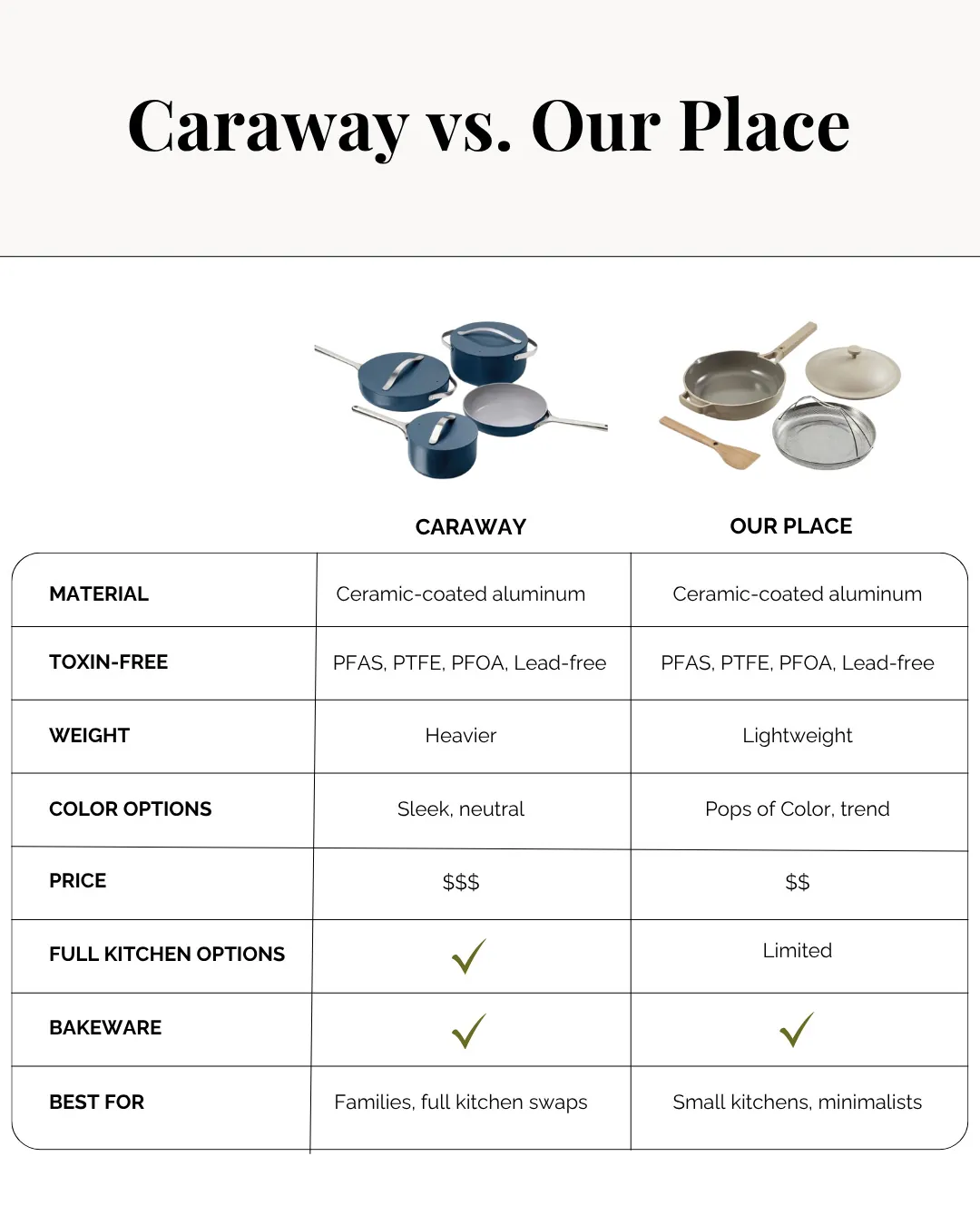
Caraway and Our Place both sell ceramic-coated nonstick cookware, but they solve different problems. Caraway wins on full-set value and oven-safe design; Our Place wins on space-saving versatility with its Always Pan 2.0. Your choice comes down to three things: how much storage space you have, how many people you cook for, and whether you want a matched set or one pan that does several jobs.
Those three factors change the answer a lot. A studio cook and a family of five will pick differently. So will someone replacing a whole cabinet versus someone buying their first good pan.
Start with cabinet space, because it decides more than the other two. If you have a deep drawer or a full cabinet to spare, buy the Caraway set. Its pans stack with their own racks, and you’ll stop hunting for a lid that fits.
If your storage is one narrow shelf, buy the Always Pan 2.0 instead. It replaces a fry pan, saute pan, steamer and strainer in a single footprint.
Cooking for one or two, the single pan is usually enough. Cooking for four or more, or roasting in the oven, the set earns its space.
Who’s actually shopping for this comparison
Three kinds of readers land on this page. The first is replacing a scratched-up set of cheap nonstick pans and wants a matched set that stores neatly. They already know they want ceramic coating, not Teflon. They need to know which brand’s set covers the most cooking tasks for the money.
The second reader has a small kitchen — a studio, a rental, a dorm — and can’t store six pans. They want one pan that boils, fries, steams and sears. Our Place’s Always Pan was designed exactly for this person.
The third reader already owns one of the two brands and is thinking about switching. They want an honest comparison of coating durability and warranty terms, not a shopping pitch.
This page serves reader one and reader two best. If you’re reader three and your current pan still works, read the warranty sections closely before you spend anything. The rest of this article assumes you’re buying your first Caraway or Our Place piece, or replacing a set that’s worn out.
What actually decides the winner
Storage space is the first filter. Caraway’s signature set includes a magnetic pan rack and lid organizer, which means the full set hangs on a wall or sits in a cabinet as one unit. Our Place’s Always Pan stacks with its own nesting system, but a full Our Place collection still takes more shelf space than a Caraway set of the same pan count. Count your cabinet depth before you decide — a 10.5-inch pan needs about 11 inches of clearance.
Cooktop type changes the recommendation. Both brands work on gas, electric and induction, but check the spec sheet for your exact model. Induction users should confirm the base is magnetic before buying — the product page for each pan lists this.
How many people you feed. One or two people can live with the Always Pan alone. Three or more, and you’ll want at least a skillet plus a saucepan, which pushes you toward a set.
Coating care habits matter more than brand. Ceramic nonstick coatings degrade faster with high heat and metal utensils. The manufacturer’s own care instructions — not the marketing copy — tell you the real limits.
The one people get wrong most: assuming ceramic coating means you can crank the burner to max. It doesn’t. Most ceramic nonstick is rated for medium and medium-high heat only, and the pan’s own documentation states the ceiling.
How to choose between them
- Measure your storage first. Write down the width, depth and height of the space where the pans will live. A Caraway set needs a flat surface roughly 20 inches wide for the rack.
- Count your burners and your people. One or two cooks, one pan. Three or more, plan for a skillet, a saucepan and a sauté pan minimum.
- Check your cooktop. Gas, electric and induction all work with both brands, but confirm the specific pan’s base material on its product page before you buy.
- Read the care instructions on the brand’s own site. Look for the maximum heat rating and the utensil guidance. Both brands publish this.
- Compare the warranty length. Caraway and Our Place both publish their warranty terms on their sites — read the exclusions, especially the coating coverage.
- Decide set or single pan. A set costs more upfront but covers more meals. A single pan costs less and stores smaller.
- Check the return window before ordering. Both brands publish their return policy online. Read it before the pan arrives, not after.
- Wash and season before first use. Follow the brand’s own first-use instructions — usually a warm soapy wash and a light oil wipe.
- Test with eggs on day one. A fried egg is the fastest test of whether the coating releases cleanly at medium heat.
- Register the warranty. Both brands ask for proof of purchase, so keep the order email.
The judgement call that separates a good buy from a regret: buy for the way you actually cook, not the way you’d like to. If you eat out four nights a week, a six-pan set is storage you’re paying for and never using.
The variations at a glance
| Your situation | What to do | What it takes | What to watch for |
|---|---|---|---|
| Studio, one cook | Buy the Always Pan alone | One pan, small shelf | Coating wear from daily use |
| Family of four | Buy a Caraway set | Full cabinet shelf | Heavy pans when full |
| Induction cooktop | Confirm magnetic base first | Check product page | Non-magnetic pans won’t heat |
| Replacing old nonstick | Compare coating warranties | Read both warranty pages | Coating exclusions in fine print |
| Gift buyer | Pick the smaller set | Gift receipt needed | Return window closes fast |
| Small budget | Start with one pan | Lowest upfront cost | Adding pans later costs more |
| Renting, moving soon | Choose lighter pans | Easier to pack | Heavy sets are a hassle |
Two rows decide most purchases, and they’re the two people read past fastest. If you have an induction cooktop, the pan’s base must be magnetic or the pan won’t heat at all. Test it with a fridge magnet before you order, not after the box arrives.
If you’re replacing an old nonstick pan, the warranty is the whole decision. Read the coating exclusions before you buy, because a warranty that skips coating wear covers almost nothing you’ll actually experience.
Everyone else can start with a single pan. One pan tells you whether you like the weight and the coating in your own kitchen, and it costs the least to be wrong about. Add the set later if the first pan earns it.
What separates a good result from a poor one

Prep before the first cook
Wash both pans in warm soapy water and dry them fully before the first use. Washing removes any manufacturing residue before the first cook.
Check your burner size against the pan base too. A small burner under a wide pan creates a hot ring in the middle and a cold edge — food browns unevenly and you blame the coating when it’s the heat pattern. Match the burner to the base within about an inch.
Heat control and what to leave alone
Medium heat does almost everything. Ceramic nonstick releases food because of its coating, so high heat adds nothing except faster coating breakdown. Preheat for one to two minutes on medium, then cook.
Two things to leave alone: metal utensils and the dishwasher. Both scratch and dull the coating faster than hand washing with wood or silicone tools. Also skip the oil spray — the ingredients in the spray leave a sticky layer that bakes on and is hard to remove without scrubbing. Use a teaspoon of liquid oil instead.
What goes wrong, and what to do
| What you notice | What it usually means | What to do first | How to stop it happening again |
|---|---|---|---|
| Food sticks in the middle | Heat too high, or coating film | Cool, wash, re-oil lightly | Cook on medium only |
| Brown ring on the base | Burner smaller than pan | Match burner to pan size | Use the right burner |
| Coating looks cloudy | Oil spray residue baked on | Warm soapy soak, soft sponge | Use liquid oil, not spray |
| Pan wobbles on the hob | Warped base from fast cooling | Stop using on that hob | Cool before washing |
| Handle feels loose | Screw loosened with heat cycles | Tighten with the right tool | Check screws monthly |
| Food tastes metallic | Coating scratched to the metal | Stop cooking in it | Replace the pan |
| Lid sticks | Steam seal, no vent open | Open the vent, wait | Vent the lid while cooking |
The rules that apply
Nonstick cookware sold in the US falls under FDA rules for food-contact materials, and the FDA publishes its guidance on cookware coatings on its site. California’s Proposition 65 also sets warning requirements for certain chemicals in cookware, and the California Office of Environmental Health Hazard Assessment (OEHHA) lists those chemicals — both brands publish their compliance statements online.
Warranty terms are contracts, not promises. Caraway and Our Place each publish their own warranty length and exclusions on their own websites, and those pages are the only version that counts. Read the coating exclusion clause before you buy, because normal wear on a coating is often excluded.
If a pan arrives damaged or the coating fails in a way you think is a defect, the route is the brand’s customer service and, if that fails, your state’s consumer protection office. Don’t try to repair a flaking coating yourself — a pan with exposed metal under the coating isn’t a DIY fix.
What it costs you
The real cost isn’t just the pan. It’s the pan plus the storage it eats, the care time it demands, and how long the coating lasts before you replace it. A set costs more upfront but spreads the cost across more meals; a single pan costs less but you may buy a second one within a year.
Prices change often, so check the brand’s own site for today’s number rather than trusting any figure here. What moves the cost up: buying a full set when you cook for one, replacing pans early because of high-heat damage, and buying oil spray instead of liquid oil. What moves it down: buying one pan that does several jobs, hand washing to extend coating life, and using the warranty when a genuine defect appears.
The hidden cost is storage. If a set doesn’t fit your kitchen, you’ll store it badly, scratch it, and replace it sooner — which costs more than the pans did.
Keeping it right afterwards
Hand wash both brands with warm water, a soft sponge and a drop of dish soap, then dry immediately. Stack pans with a felt or cloth protector between them so the coatings don’t rub. Store lids flat or on the rack, not leaning, to avoid warping.
Skip the dishwasher even on a dishwasher-safe label. The detergent is harsher than dish soap and the dry cycle bakes on residue, so a pan that survives a few cycles still ages faster than one washed by hand. If you know you won’t hand wash it, buy the cheaper of the two.
The sign a pan needs attention: food starts sticking in one spot even at medium heat, or the coating looks dull and patchy. That’s coating wear, not dirt. A warm soapy soak and soft scrub fixes residue; it won’t fix worn coating.
Test it before you toss it. Boil water in the pan for a minute, pour it out, and look at the surface while it’s still wet.
Don’t restart the whole process when one pan in a set wears out. Replace that single pan if the brand sells it separately, and keep the rest. Check the brand’s site for individual pan availability before assuming you must rebuy the set.
When this isn’t the right call
If you cook on high heat constantly — searing steaks, wok-style stir fry — ceramic nonstick is the wrong tool. Carbon steel or cast iron handles high heat and lasts decades. Buy those instead.
If you want one pan for life and don’t mind seasoning it, skip both brands and get cast iron. It’s cheaper and outlasts any coating.
If your stovetop is induction, check the base before you buy. Ceramic nonstick pans need a magnetic layer bonded into the bottom to work on induction at all. The box will say induction-compatible if it is. If it doesn’t say it, assume it won’t heat.
If you have a diagnosed respiratory condition and are worried about fumes from overheated nonstick, talk to your doctor rather than relying on a shopping guide. And if a coating is flaking into your food, stop using that pan and contact the manufacturer — don’t sand it or repair it yourself.
Frequently asked questions
Is Caraway better than Our Place?
Neither is better overall — they fit different kitchens. Caraway suits cooks who want a matched set with a storage rack and cook for three or more people. Our Place suits small kitchens and one or two cooks who want one pan doing several jobs. Match the brand to your space and household size, not to reviews.
Can you use metal utensils on Caraway or Our Place pans?
No — both brands advise against metal utensils on their ceramic nonstick coatings. Use wood, silicone or plastic. Metal scratches the coating, and scratches expose the layer underneath, which makes food stick and can shorten the pan’s life. Check each brand’s own care page for its exact wording.
How long do Caraway and Our Place pans last?
Both brands publish their warranty length on their own sites, and that’s the number to check. Coating life depends on heat and utensil habits more than brand. Cook on medium, hand wash, and skip oil spray, and the coating lasts longer than if you use high heat and metal tools.
Are Caraway and Our Place pans induction compatible?
Most current models from both brands work on induction, but not every pan in every line does. Check the specific product page for the words “induction compatible” before buying. A quick test: if a magnet sticks firmly to the base, the pan will work on an induction cooktop.
Is ceramic nonstick safe if it gets too hot?
Ceramic coatings don’t contain PTFE, so they don’t release the fumes associated with overheated Teflon. But overheating any nonstick pan degrades the coating and shortens its life. Keep to medium and medium-high heat, and if a pan smokes badly, turn off the burner, ventilate the room and let it cool.
What happens if the coating starts flaking?
Stop cooking with that pan. Flaking means the coating has failed and metal is exposed. Contact the brand’s customer service with your order number and photos — if it’s a defect within the warranty window, they may replace it. Don’t sand or repair the coating yourself.
Does it matter which one I buy first?
Yes, if you’re building a set over time. Pick the brand whose single pan you like before committing to a full set, because the coating feel and handle weight differ between them. Buy one pan, cook with it for a month, then decide whether to add more from the same line.
Can I put either brand in the dishwasher?
Both brands recommend hand washing to protect the coating, even when the pan is labeled dishwasher safe. Dishwasher detergent and high heat dull ceramic coatings over time, so if you must use the dishwasher, do it rarely.

Hello, This is Annie Walker, a 38-year-old blogger, founder, and editor of Cookware Guider from NY, USA. I am a cookware fanatic and passionate cooker. I love to cook with different types of cooking appliances (example: all types of cookware, rice cookers, slow cookers, etc) almost every day in my kitchen. I love to share my experience with my readers in my blog. Also, I enjoy helping people to solve their problems through my website. You can follow me on Twitter & Pinterest. To know details about my blog please check the about us page.