
Knives are an essential part of every kitchen, workshop, and outdoor adventure. Yet, even the best knife becomes frustrating and unsafe if it loses its edge. Dull knives make tasks harder, require more force, and can slip easily, leading to accidents. That’s where knife sharpeners come in. But how do these devices actually work? If you’ve ever wondered about the science and mechanics behind a sharp blade, this article will give you a clear, detailed explanation. We’ll explore different types of sharpeners, the materials they use, and how they bring your blade back to life. Whether you’re a home cook, a craftsman, or just curious, understanding how knife sharpeners work can help you take better care of your tools and even improve your cutting skills.
The Basics Of Knife Sharpening
At its core, sharpening a knife means removing small amounts of metal from the blade’s edge to create a finer, sharper point. Over time, with use, a knife’s edge gets worn down, rolled over, or chipped. The sharp edge becomes rounded and cannot cut as effectively.
Knife sharpeners work by using abrasive materials—substances harder than the steel of the blade—to grind away this worn metal. By controlling the angle and pressure, sharpeners reshape the edge to a specific angle that slices cleanly.
There are two main processes in knife sharpening:
- Sharpening: Removing metal to create a new edge.
- Honing: Straightening and realigning the edge without removing much material.
Many people confuse honing with sharpening. A honing rod does not actually sharpen; it simply fixes the edge that may have bent out of shape. True sharpening involves abrasives that grind metal away.
Understanding Blade Angles And Edge Geometry
A knife’s sharpness and durability depend on its edge angle—the angle between each side of the blade edge. Most kitchen knives have an angle between 15 to 20 degrees per side. Outdoor or heavy-duty knives may have wider angles for strength.
Why Does Angle Matter?
- Smaller angles (like 15°) create a sharper edge, perfect for slicing but less durable.
- Larger angles (like 20–25°) are more robust, suitable for chopping and tougher tasks.
Sharpeners are designed to help you achieve and maintain the right angle. Using the wrong angle can make a blade either too weak or not sharp enough.
Types Of Knife Sharpeners
There are several kinds of knife sharpeners, each using different methods and materials. Understanding their differences can help you choose the best one for your needs.
Manual Sharpeners
Manual sharpeners are popular in home kitchens. They are simple, compact, and easy to use.
Pull-through Sharpeners
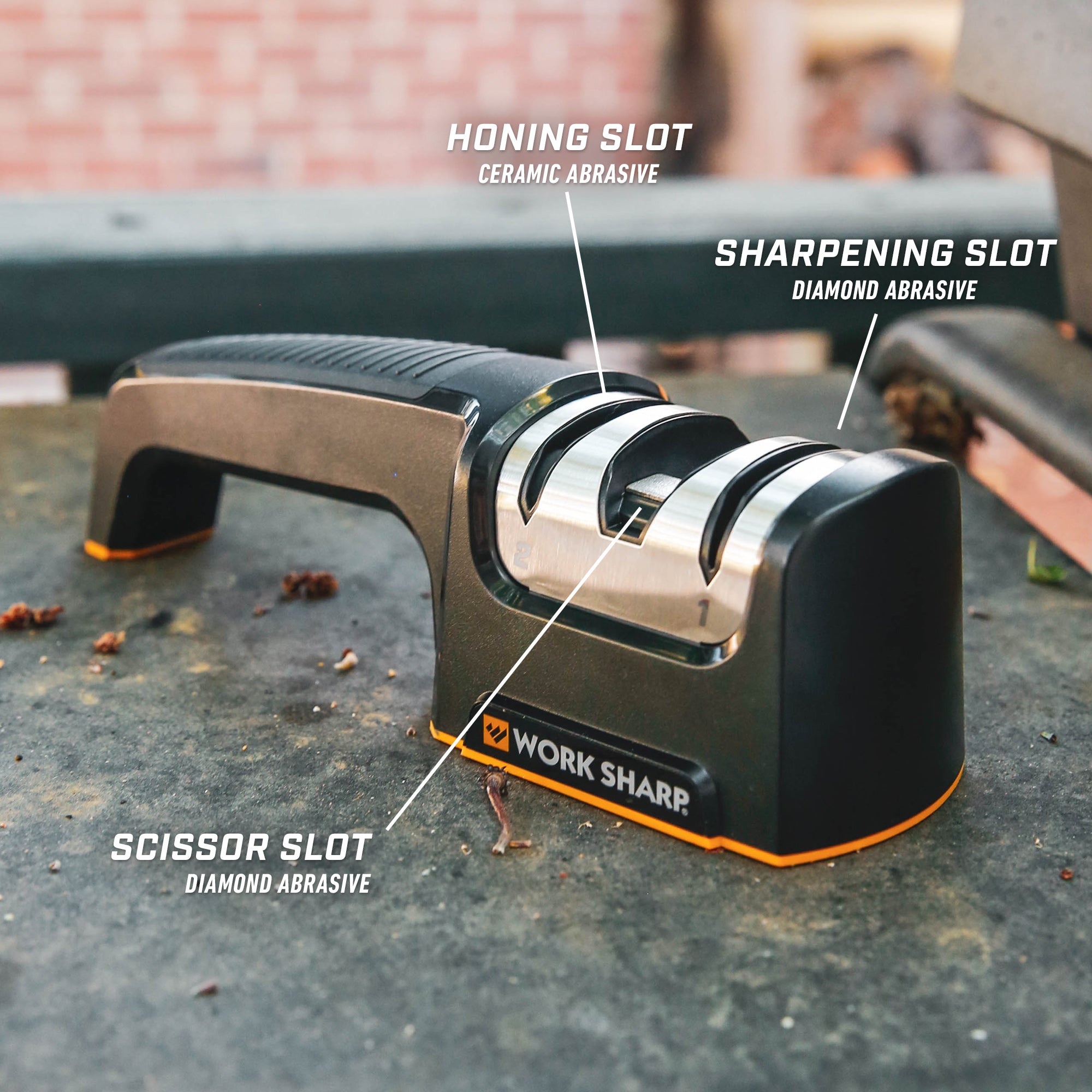
These have a slot with abrasive surfaces. You pull the knife through the slot, and the abrasives grind the edge.
How they work:
- Abrasive wheels or plates (usually ceramic, diamond, or carbide) are set at a fixed angle.
- When you pull the blade through, these materials grind away dull metal and reshape the edge.
- Some models have multiple slots for coarse and fine sharpening.
Advantages:
- Quick and easy for beginners.
- Preset angles reduce guesswork.
Limitations:
- Less control over sharpening angle.
- Can wear down knives faster if used too often.
Whetstones (sharpening Stones)
Whetstones are the most traditional and versatile sharpening tools.
How Whetstones Work
- Made from natural or synthetic abrasive materials.
- Require water or oil to help remove metal filings and keep the stone clean.
- The knife is drawn across the stone at a consistent angle, grinding away metal to form a new edge.
Whetstones come in different grit sizes:
- Coarse (200–600 grit): For very dull or damaged blades.
- Medium (800–2000 grit): For regular sharpening.
- Fine (3000+ grit): For polishing and finishing the edge.
Using a whetstone takes practice but offers the best control over edge angle and finish.
Electric Sharpeners
Electric knife sharpeners are popular for their speed and convenience.
How Electric Sharpeners Work
- Use spinning abrasive wheels powered by a motor.
- The knife is inserted into a slot, and the spinning wheels quickly grind the edge.
- Most have several stages: Coarse, medium, and fine, each using different abrasives.
Benefits:
- Fast and easy, even for beginners.
- Consistent results due to fixed angles.
Downsides:
- Can remove more metal than necessary.
- Less control for specialized knives.
Honing Rods And Steels
Although not true sharpeners, honing rods are vital for knife maintenance.
How Honing Rods Work
- Made from steel, ceramic, or diamond-coated materials.
- Used to realign the edge of the blade, not to remove metal.
- Regular honing keeps knives sharper between sharpenings.
Guided Sharpening Systems
These devices hold the knife and sharpening stones at a fixed angle.
How They Work
- Knife is clamped in place.
- Abrasive stones or rods are moved across the edge at a set angle.
- Offers high precision and repeatability.
Guided systems can be manual or use small motors.
The Role Of Abrasive Materials
Abrasive materials are what actually do the sharpening. They must be harder than the steel of your knife.
Some common abrasives:
- Diamond: The hardest material, cuts very fast, used in high-end sharpeners.
- Ceramic: Hard and durable, good for fine finishing.
- Carbide: Very hard and aggressive, removes metal quickly, often used for coarse sharpening.
- Aluminum oxide: Common in synthetic whetstones.
The size and type of abrasive determine how much metal is removed and how smooth the finished edge will be.
Here’s a quick comparison of abrasive materials used in sharpeners:
| Abrasive Type | Hardness | Speed of Sharpening | Best For |
|---|---|---|---|
| Diamond | Very High | Fast | All knife types |
| Ceramic | High | Moderate | Finishing, honing |
| Carbide | Very High | Very Fast | Coarse sharpening |
| Aluminum Oxide | Medium | Moderate | General sharpening |

Credit: ca.brodandtaylor.com
The Sharpening Process Step By Step
While different sharpeners work in unique ways, the basic steps of sharpening a knife are similar.
- Assess the Blade: Check for nicks, chips, or dullness.
- Choose the Right Abrasive: Start with a coarse abrasive for very dull blades, finish with a fine one.
- Set the Angle: Hold the knife at the correct angle for your blade type.
- Sharpen Each Side: Grind evenly on both sides to form a symmetrical edge.
- Polish and Hone: Use finer abrasives to smooth and polish the edge.
- Test the Edge: Carefully check sharpness with paper or a tomato.
Many beginners forget to maintain the same angle during sharpening. This is crucial for a uniform, sharp edge.
Manual Vs. Electric Sharpeners: Which Is Better?
Both types have their strengths and weaknesses. The best choice depends on your needs, skill level, and the knives you own.
| Feature | Manual Sharpeners | Electric Sharpeners |
|---|---|---|
| Speed | Moderate | Fast |
| Control | High | Medium |
| Skill Needed | More | Less |
| Price | Usually lower | Usually higher |
| Maintenance | Simple | May need replacement parts |
| Knife Wear | Less (if used properly) | More (if overused) |
Non-obvious insight: Electric sharpeners are fast, but they can quickly wear down thin or expensive knives. For Japanese knives or high-carbon blades, manual sharpeners or whetstones are often safer.
How Sharpeners Handle Different Knife Types
Not all knives are created equal. The best sharpening method depends on the blade’s design and steel.
- Western knives often use softer stainless steel and have a 20-degree angle. They work well with most sharpeners.
- Japanese knives have harder, thinner steel and sharper angles (12–15 degrees). They require more gentle, precise sharpening—whetstones are best.
- Serrated knives need special sharpeners or professional help, as regular sharpeners can damage the teeth.
- Ceramic knives are extremely hard; only diamond abrasives can sharpen them.
Pro tip: Check your knife’s manufacturer guidelines before sharpening. Using the wrong tool or angle can permanently damage the blade.
Sharpening Myths And Mistakes
Many people have misunderstandings about sharpening. Let’s clear up a few:
- Myth: “Honing rods sharpen knives.”
*Reality:* They only realign the edge; they don’t remove metal or create a new edge.
- Myth: “You should sharpen knives often.”
*Reality:* Over-sharpening wears down blades quickly. Most home cooks only need to sharpen every few months, with regular honing in between.
- Myth: “Any sharpener will do.”
*Reality:* Matching the sharpener to your knife’s steel and angle is critical for performance and safety.
- Mistake: Using too much force.
*Tip:* Let the abrasive do the work. Excess pressure can damage both blade and sharpener.
- Mistake: Ignoring grit progression.
*Tip:* Always move from coarse to fine abrasives for the best edge.
Safety And Care Tips
A sharp knife is safer than a dull one, but sharpening involves risks. Here are ways to stay safe and extend the life of your knives:
- Always keep your fingers away from the blade’s path.
- Use a non-slip mat or base for manual sharpeners and stones.
- Clean your knife after sharpening to remove metal filings.
- Store knives in a block or sheath to protect the edge.
- Don’t use glass or ceramic plates as cutting boards—these dull blades quickly.
Hidden insight: Most accidents happen not while sharpening, but when using a dull knife. A sharp blade requires less force and is more predictable.
Key Features To Look For In A Knife Sharpener
If you’re thinking of buying a knife sharpener, consider these important features:
- Abrasive Material: Diamond and ceramic are top choices for most users.
- Angle Guides: Help ensure consistent sharpening, especially for beginners.
- Grit Options: Multiple grits (coarse, medium, fine) let you restore, sharpen, and polish with one tool.
- Knife Compatibility: Make sure it suits your knife type—especially if you own Japanese or serrated knives.
- Ease of Cleaning: Removable parts or open designs are easier to maintain.
- Safety Features: Non-slip bases, finger guards, and stable construction are essential.
The Science Behind Sharpness
Why does a sharper edge cut better? It’s all about edge geometry and friction. A sharper knife concentrates force on a smaller area, letting it move through food or material with less resistance.
Research shows that a knife edge thinner than a human hair (about 0. 1 mm) can slice easily through most foods. Over time, microscopic dents and rolls form on the edge, increasing friction and reducing cutting power. Abrasives in sharpeners restore the fine edge by removing these imperfections.
Interesting fact: According to a study by the University of Sheffield, even a small difference in edge angle (like 15° vs. 20°) can double a knife’s sharpness and halve the force needed to cut.
How To Test Knife Sharpness
After sharpening, you want to know if your knife is truly sharp. Here are simple ways to check:
- Paper Test: Slice a sheet of paper. A sharp blade cuts cleanly without tearing.
- Tomato Test: Try slicing a ripe tomato. A sharp knife should break the skin easily and make thin, even slices.
- Shaving Hair: Some experts check if the knife shaves arm hair, but this is not recommended for safety reasons.
- Visual Inspection: Look closely at the edge under bright light. A sharp edge reflects little or no light.
If your knife fails these tests, repeat the fine sharpening or honing steps.
Credit: worksharptools.com
Environmental And Economic Impact
Sharpening knives extends their life and reduces waste. Every year, millions of knives are thrown away because they’ve become dull, but with proper sharpening, most can last decades.
A high-quality sharpener costs much less than replacing knives. Also, sharpening at home saves time and money compared to professional services.
From an environmental perspective, using and maintaining tools longer reduces the need for new resources and lowers your carbon footprint.
Sharpening Frequency: How Often Is Enough?
How often you should sharpen depends on how much you use your knives and what you cut.
- Home cooks: Every 2–3 months, with weekly honing.
- Professional chefs: Often sharpen weekly, hone daily.
- Outdoor knives: Sharpen after heavy use or before each trip.
If your knife feels dull or struggles with basic tasks, it’s time to sharpen.
Real-world Examples
Consider these two scenarios:
- Home chef: Sarah uses her chef’s knife daily. She sharpens it with a manual pull-through sharpener every three months and hones it weekly. Her knife stays sharp and safe for years.
- Outdoor enthusiast: Mike carries a folding knife on hikes. He uses a portable diamond sharpener after each camping trip. His knife remains reliable for cutting rope, food, and wood.
These examples show how different sharpeners fit different lifestyles.
Professional Sharpening Services
If you’re not confident sharpening expensive or specialty knives, professional services are available. They use precision tools and have experience with all blade types. Prices vary but range from $5 to $15 per knife.
Note: Even if you use a service, regular honing at home helps maintain the edge longer.
For more on knife sharpening and blade care, reputable resources like Wikipedia offer additional technical details.

Credit: www.youtube.com
Frequently Asked Questions
What Is The Difference Between Sharpening And Honing?
Sharpening removes metal to create a new edge, while honing realigns the existing edge without removing much metal. Honing keeps a sharp knife performing well between sharpenings.
Can I Use Any Sharpener For Any Knife?
No. The best sharpener depends on your knife’s steel, angle, and design. For example, Japanese knives need finer abrasives and gentler handling than Western knives. Always check your knife’s requirements before sharpening.
How Do I Know If My Knife Is Sharp Enough?
Try slicing a sheet of paper or a tomato. A sharp knife cuts easily and cleanly. If it struggles or tears, it needs more sharpening or honing.
Are Electric Sharpeners Bad For Knives?
Not necessarily, but they can remove more metal than needed and may wear down knives faster. Use electric sharpeners carefully and only when needed, especially with thin or expensive blades.
How Long Does A Good Sharpener Last?
With proper use and care, a quality sharpener—manual or electric—can last many years. Clean abrasives regularly and avoid using excessive force to extend its lifespan.
Taking care of your knives with the right sharpener keeps them safer, sharper, and more enjoyable to use. By understanding how knife sharpeners work and choosing the right tool, you can keep your blades in top shape for years to come.

Hello, This is Annie Walker, a 38-year-old blogger, founder, and editor of Cookware Guider from NY, USA. I am a cookware fanatic and passionate cooker. I love to cook with different types of cooking appliances (example: all types of cookware, rice cookers, slow cookers, etc) almost every day in my kitchen. I love to share my experience with my readers in my blog. Also, I enjoy helping people to solve their problems through my website. You can follow me on Twitter & Pinterest. To know details about my blog please check the about us page.